

The Art of the Unfinished: Inside Loüable’s RAW EDGE Residency
During Montreal Fashion Week, Espace Loüable became home to the RAW EDGE artistic residency, where four artists created and displayed their work. Founded by Cassandre Brillant, the designer, artist, and entrepreneur behind La fille de Priam, Loüable is a unique studio-gallery space that supports multidisciplinary practices and breaks down barriers between creative industries.
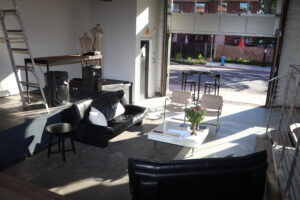
Gathering area in Espace Louable, Image courtesy of Espace Loüable.
Discussing the RAW EDGE theme with Brillant, she said she selects themes that mirror her personal life. The residency followed Page Blanche, her first residency in January, reflecting start-of-year energy and new beginnings. Nine months later, RAW EDGE reflects a new period in Brillant’s life.
“Now, mid-year, we’re feeling raw,” said Brillant. RAW EDGE focuses on that feeling. Centred on the unseen, unshown, and unfinished side of fashion and art, it brought the usually hidden stages of creation into view and invited both artists and audiences to embrace work still in progress.
Magaly Lafontaine, Maïa Carrier-Pelletier, Miss Bisous, and Brillant were the artists of this twelve-day residency. Two days before the finissage, we met for a group conversation in the centre of their shared workspace to talk practice, process, and production. Seeing the completed works at the finissage brought those conversations into sharper focus, revealing how the ideas, methods, and experiences they had described took form in the work itself.
Magaly Lafontaine
Magaly Lafontaine is a visual and media arts student at UQAM whose practice spans sculpture and installation. Interested in the relationship between the body and textiles, she explores the marks that time leaves on both, challenging the stigma surrounding bodily imperfections and what she calls “traces of time.”
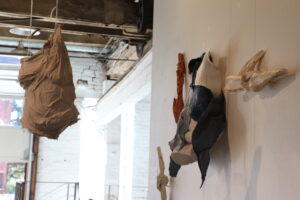
Image courtesy of Espace Loüable.
For RAW EDGE, Lafontaine laid pieces of distressed denim over a mould of her own body, drawing a parallel between the aging of clothing and the aging of the body. Both carry traces of life; scars can only be created by living, and distressing only by wear. “I want to show that it’s beautiful to have traces of you that prove that you are living,” said Lafontaine.
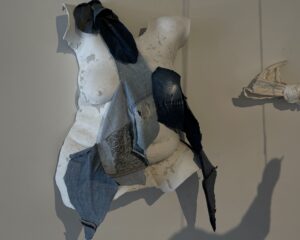
Image courtesy of Espace Loüable.
By placing those traces at the centre of the work rather than concealing them, Lafontaine challenges the polished, retouched bodies we are accustomed to seeing. Her work reframes signs of aging and imperfection not as flaws to erase, but as physical evidence of a life being lived.
Maïa Carrier-Pelletier
Maïa Carrier-Pelletier, also a visual and media arts student at UQAM, explores the relationship between private and public space and the ways our surroundings help construct identity. For RAW EDGE, she used second-hand materials sourced from local thrift stores to create two intricate couture pieces—a horned headpiece embellished with lace and ornate trimmings, and a romantic, draping garment with cascading fringe and sculptural folds along the neckline.
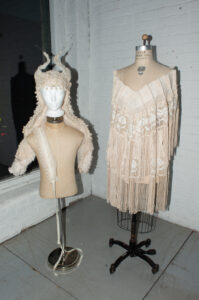
Image courtesy of Espace Loüable.
They were displayed next to two large photographs: one showing Carrier-Pelletier wearing her pieces, and the other capturing the shadows her work cast across the walls of Loüable. In both, the residency space becomes part of the work itself.
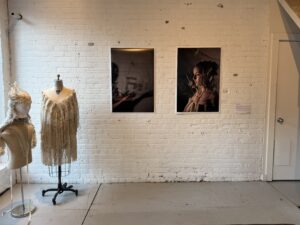
That relationship between space and creation extended into the finissage. Carrier-Pelletier’s scrap textiles, tools, and sewing machine remained visible across from the finished pieces, allowing the workspace and exhibition space to exist side by side. Rather than separating the private process of making from its public presentation, the display brought both into view at once—a fitting extension of her interest in where those boundaries begin and end.
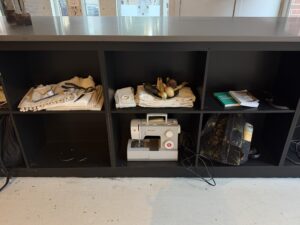
Carrier-Pelletier’s storage area
Cassandre Brillant
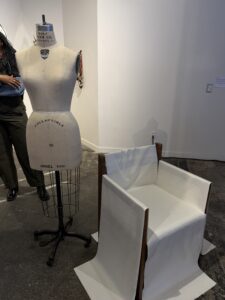
Titled “Sit With It,” Brillant created an immersive experience that allowed her audience to literally sit down on reworked vintage chairs and observe a series of silhouettes created directly on dress forms. Each dress form represented a different stage of the artistic process and the emotional reality of being an artist-entrepreneur.
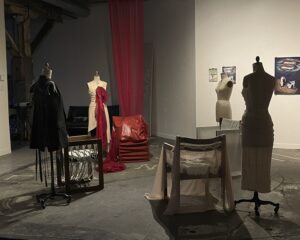
“Sit With It” by Cassandre Brillant, Image courtesy of Espace Loüable.
In our chat about balancing those roles, Cassandre talked about the increasing pressure on independent artists to “play the game” of content creation—the artist becomes the “vitrine,” creating both the art and the artist’s image. In “Sit With It,” we are invited into the artists’ world in a way that is far less momentary, and far more intimate. Rather than encountering a finished product designed to capture attention instantly, the audience is asked to sit with the stages, uncertainty, and emotional labour behind creation.
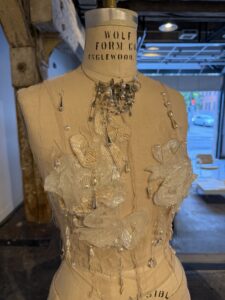
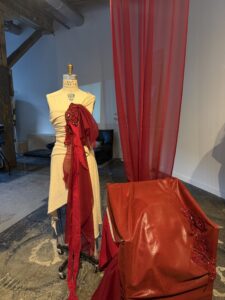
There is an interesting tension here with Brillant’s description of the artist as the “vitrine.” While social media pressures artists to continually present a coherent, polished image of themselves and their work, “Sit With It” exposes what sits behind that image: experimentation, uncertainty, labour, and works still in formation.
Miss Bisous
Miss Bisous, also known as Nino the clown, is a multidisciplinary artist working across performance, sculpture, drawing, painting, theatre, and clowning. During our conversation, she said that she’s “not really interested in newness or realism,” instead repurposing discarded objects from different worlds to create entirely unique ones.
For RAW EDGE, Miss Bisous revisited her past work “Catin des bois” through a series of painted studies. Using taxidermy deer and moose hooves that would otherwise be discarded, her original work transformed the material in an unexpected and jarring way, attaching the hooves to dancing shoes and cowboy boots.
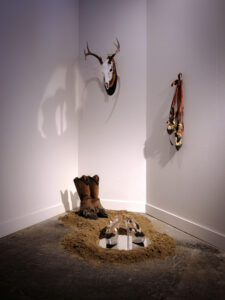
“Catin des Bois” by Miss Bisous, Image courtesy of Espace Loüable.
While the finished installation foregrounded the object’s strangeness, Miss Bisous realized audiences had little access to the rigorous—and at times unpleasant—process behind its creation. Her RAW EDGE studies bring that process back into view. She painted the original dancing shoes to which the hooves had been attached and displayed a cutout of the borax used to preserve the animal skins.
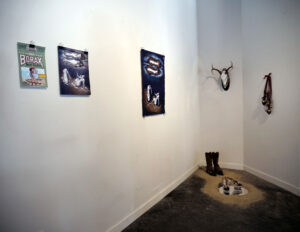
Miss Bisous’s full display for RAW EDGE, Image courtesy of Espace Loüable.
Often incorporating humour into her work, Miss Bisous titled her study “PEEYU,” poking fun at both the smell of her overused dancing shoes and the less glamorous material realities behind the taxidermy process. In this way, her RAW EDGE work shifts attention from the finished object to the messy, physical process that produced it.
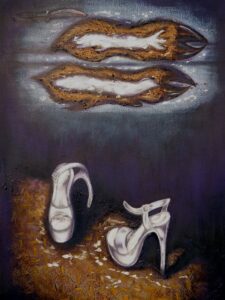
“PEEYU” study by Miss Bisous, Image courtesy of Espace Loüable.
That impulse to expose what usually remains behind the finished work extended across the residency.
By the finissage, RAW EDGE had made visible what creative work often asks audiences to overlook: the scraps, revisions, uncertainty, labour, and material traces behind a finished piece. Across four very different practices, the residency treated those usually hidden stages not as something to move past, but as part of the work itself. In doing so, Loüable also demonstrated the value of spaces that allow disciplines, processes, and artists to overlap—creating room not only for finished work to be shown, but for experimentation and exchange to remain visible.
By Sarah Rodrigues