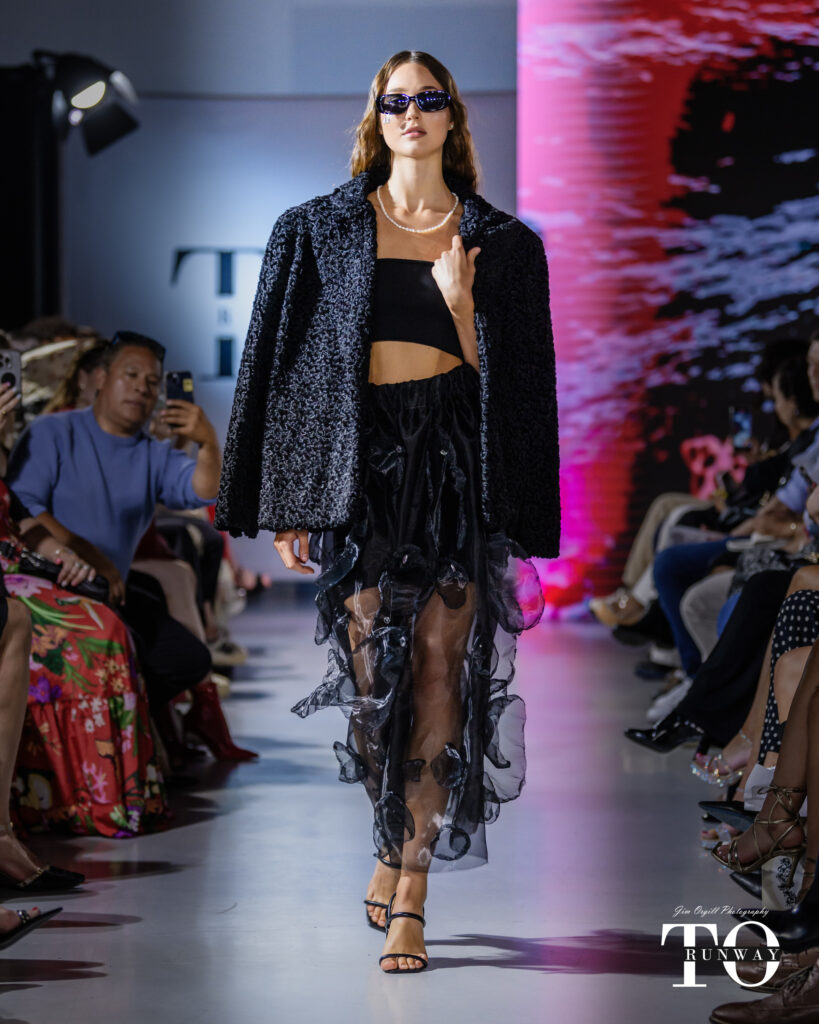


Celebrating Ten Years of Miami Fashion Week
Nov 1, 2026
Miami’s 2026 edition timely prompts a practical question: what if fashion week was designed not only as a setting for creations, but also to foster creativity, accessibility and purchase opportunity? The answer lies in the space between the runway steps and the retail floor.
From October 13–18, 2026, Miami Fashion Week celebrated its ten years anniversary edition and sets the sceneries of Miami as a fashion destination of its own. Six days of fashion shows and special events took over the city, moving through Freedom Tower, Mr. C Coconut Grove, Miami Dade College’s Wolfson Campus and, for the first time, Miracle Mile in Coral Gables.
The event anchored Latin American design and turned the runway into something audiences could attend, learn from, hear and buy.
Miami as an international fashion hub
The runway listed Beatriz de la Cámara, Jenny Polanco, Jacqueline Then, Giannina Azar, Jhoan Sebastian Grey, Vero Diaz, Yenny Bastida, Efraín Mogollón and Sitka Semsch, most showing at the Freedom Tower.
A global reach through local identity is the event’s core proposition. Institutional recognition supports its ambition. MIAFW appears on the CFDA Fashion Calendar’s important dates alongside New York, London, Paris and Milan. The pipeline is also widening: Sebastian Grey’s runway slot was his prize as a Virtual Fashion Awards winner.
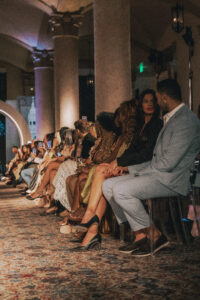
Photo by Gabriela Haydée
A Purpose that Extends Far Beyond the Runway
The anniversary’s boldest experiment was the first MIAFW x Stitch Lab pop-up Coral Gables. More than 20 designers from Latin America and beyond sold ready-to-wear, eveningwear, handbags, shoes and jewelry at the retail pop-up where customers could shop there whatever they saw on the runway. The direct route lets buyers learn the label’s pricing, delivery capacity and key pieces while the interest is still fresh and beyond the invited audience.
Participants include NNT, Amarante, IT Shoes, Entos, Ana + Maria, Marea Alta, Paola Pacheco, Franchesca Miranda, Maria Angelica Guerra, Muzaluci, Pampa, Adriana Fernandez, Nerea, Ojo de Leon, Beatriz de la Camara, Sebastian Grey, Renata Lozano, Vero Diaz, Andres Otalora, Yenny Bastida, Alta, Jenny Polanco, Adriana Cobo, and Hara.
The day before the runway’s kick-off, on Wednesday, October 14th, the event hosted a nine-panel Summit at Miami Dade College spotlighting the growing intersection of fashion, digital creativity, artificial intelligence, and emerging technologies through conversations between designers and voices from across the fashion industry. Panelists explored using AI to innovate their creative work and business models.
Covering the Runways
Agenda
Friday, October 16 moves to Freedom Tower at Miami Dade College: Jacqueline Then at 5:30 p.m., Giannina Azar at 7 p.m., and Jhoan Sebastian Grey at 8:30 p.m.
Saturday, October 17 at Freedom Tower, with Vero Diaz at 5:30 p.m., Yenny Bastida at 7 p.m., and Efraín Mogollón at 8:30 p.m.
Sitka Semsch closes the runway agenda on Sunday, October 18 at noon on Miracle Mile.
Designer’s background and they runway aesthetics:
Jhoan Sebastian Grey @iamsebastiangrey
Born in Cali, Colombia, Grey got his start working in his family’s leather business. His interest in fashion began through his practices as a ballet dancer. He went on to study fashion design at the Academy of Professional Drawing in Colombia and Istituto Marangoni in Miami. Throughout the conversations at the Summit, Sebastian shows much gratitude for his mentor, Andres Otalora, who headlined the MIAFW Gala.
His most remarkable award was Project Runway Season 17 with a Colombian-inspired collection judged by a panel that included Diane von Fürstenberg and Nina Garcia. The prize was the largest in the show’s history: $250,000, a feature in Elle, and $50,000 toward a studio.
My interview with Jhoan Sebastian Grey
Best quotes:
“I don’t consider myself a genius in fashion, but being honest with myself is the thing that makes me more honest with my work.”
“By embracing my mistakes, my culture, my craziness… embracing who I am and not feeling embarrassed of my flaws and the things people will find weird in me — I think those are the things that are making my brand stand out.”
“I’m always very touchy. I always like the way it’s going to feel in the body, the structure.”
Grey introduced himself as a designer of women’s ready-to-wear. When I asked about his creative “genius.” He turned down the label and said his strength is honesty: accepting his mistakes, his culture, his “craziness” and his flaws, without being embarrassed by what other people might find strange about him. He believes that self-acceptance is what makes his brand stand out.
Then I asked which sense guides his design. He answered right away that it’s touch: he cares most about how a garment will feel on the body and about its structure. That fits his reputation for soft, light designs.
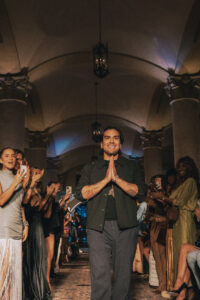
Photo by Gabriela Haydée
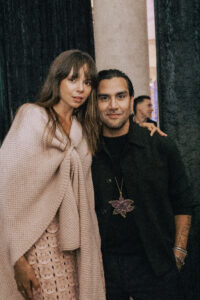
Photo by Gabriela Haydée
Interviewing Grey’s model Marina Haydée
Quotes:
“When I found out the show was for Sebastian Grey, I couldn’t believe it at first, because I’ve been following his beautiful career since 2019, after Project Runway! But I definitely realized it was meant to be his show when I met him in person during the fitting. Such a passionate soul, so devoted and absorbed in his work, in every single detail — not to mention the charismatic and fun aura he and his team have!”
“Stepping onto the runway, under those lights, with everyone watching, I felt pure presence. It wasn’t just about modeling the clothes; it was about embodying the story he created. The energy in the room was electric, and in that moment, all the synchronicities that led me there made perfect sense.”
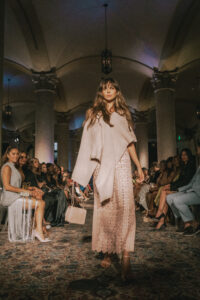
Photo by Gabriela Haydée
Giannina Azar @ Giannina Azar
She was born in Santo Domingo, Dominican Republic, and studied design at Universidad APEC and the University of Miami. She is of Lebanese descent and both sides of that heritage shaped her style by captivating baroque ornamentation and by the bursts of color of the Dominican.
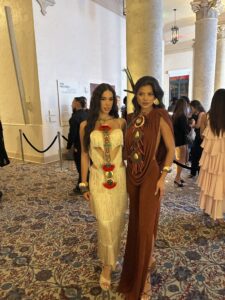
Photo by Photo by Joana Cezar Kebss de Macena
The brand’s signature
Giannina shows exuberant collections highlighting craft and fine art traditions. The runway in Miami was a multisensory theatrical stage. The tribal sounds intertwined with colorful, fluid and embroidery silhouettes. Her signature revolves around dramatic, heavy hand-beading, intricate embroidery, and fluid metallic textures crafted by artisans in the Caribbean and Latin America.
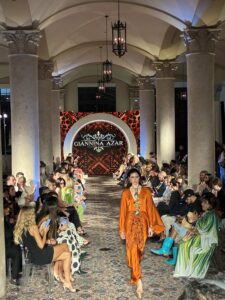
Photo by Photo by Joana Cezar Kebss de Macena
Yenny Bastida @yennybastida
As a Venezuelan designer, she bases her production in Chivacoa, where she trains and employs local women, empowering them to build skills for professional independence. Yenny is described as a pioneer of sustainable luxury in Latin America, built on artisan collaborations that preserve traditional techniques.
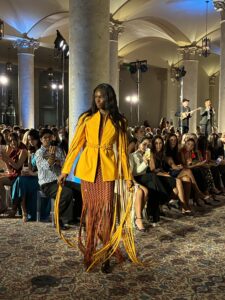
Photo by Joana Cezar Kebss de Macena
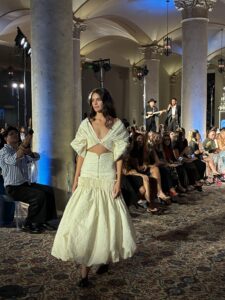
Photo by Joana Cezar Kebss de Macena
The brand’s signature
A live band playing Latin songs set the stage for her runway in Miami, reviving Venezuelan fibers and methods such as the foot loom. The vibrant colors and fringes matched the playful atmosphere of her theatrical rise at Freedom Tower.
Inspired by the Tamunangue traditions and ancestral rhythms of her home state of Lara, the “Morena del Alma SS27” collection debuted with live musical by Daniel Requena and maracaspieler Carlos Díaz playing iconic Venezuelan tracks. The runway designs transitioned from pristine linens to vibrant shades drawn from colonial era, worn by an inclusive runway cast reflecting diverse ages and backgrounds.
MIAFW Trends 2026–2027
When we talk about trends for 2026–2027, there’s one thing we simply have to mention: FRINGES.
Spanning almost all collections during Miami Fashion Week 2026. Explored in vastly different ways, yet all sharing one common trait: pure movement.
Fringes follow the body, swaying with every step and adding new nuances to the outfit. It’s as if the wearer’s own movement becomes an integral part of the look’s construction. And that completely shifts how we perceive a garment.
On the runways, we saw fringe on skirts, dresses, tops, trousers, and accessories.
We saw fringes in a variety of lengths, materials, and textures: ranging from delicate, fine strands to voluminous, embroidered, and high-shine embellishments. One specific trait of fringes got my eyes for these collections: intentional use of elongated fringe along sleeves and hems. Multiple skirts anchored the body in solid fabric at the waist before dissolving into cascading strands, allowing fringe alone to construct the true length and movement of the silhouette.
The fringes brought a sense of lightness and ease to ensemble, injected personality into tailored pieces, and transformed a formal gown into a high-impact, striking look. Combined with embroidery, beadwork, and sophisticated fabrics, it created an effect of motion and radiance that followed every gesture on the runway, making the overall look even more striking.
While Giannina Azar brought unapologetic maximalism, bursting with vibrant color and rich ornate textures, Jhoan Sebastian Grey grounded his vision in a neutral palette and placed leather at the heart of his collection, exploring the full spectrum of tactile possibilities the material offers when transformed into fringes (whether swaying freely or intricately intertwined, all executed with painstaking attention to detail).
Across every show, traditional craftsmanship was exalted. Honoring Latin America’s rich artisanal lineage and highlighting the most expressive combinations of identity, style and precision.
So, have you embraced fringe yet? I certainly plan to.
Turning sensory experience into timeless pieces
Walking through the aisles of the Stitch Lab pop-up, surrounded by the latest trends, I found myself leaning in and examining what each garment was crafted from. Appreciation for pieces that endure for decades is by no means new. Yet as cultural discourse around both sustainability and personal wellness evolves, consumer awareness is expanding: consumers are scrutinizing what they place on their skin with the same care as what they nourish their bodies with. It’s about breathable fabrics that feel beautiful on the skin, endure through time, and transcend seasonal trends. Choosing natural materials is an investment in longevity and everyday well-being.
Linen and cotton dominated the majority of collections at the pop-up. Both textiles are naturally breathable, highly absorbent, and hypoallergenic. For many conscious consumers, prioritizing plant-based fibers is a direct effort to eliminate clothing made with plastics. As research exposes the pervasiveness of microplastics and chemical residues, shoppers are actively reducing their exposure by avoiding polyester and nylon. Renowned for their inherent fiber strength and durability, linen and cotton remain unrivaled for pieces designed for frequent wear and washing. With 73% of U.S. consumers naming cotton their fabric of choice in a 2024 survey, its popularity comes as no surprise. Lightweight and naturally breathable, soft cotton offers a gentle, luxurious feel against the skin.
Gen Z, projected to command $12 trillion in spending power by 2030, is redefining modern commerce through value-driven consumption. For this cohort, purchasing decisions are rarely transactional; they are governed by brand authenticity, social consciousness, and a demand for genuine ethical alignment.
The Comfort Perspective Across the Runway Trend
The elevation of natural textiles across the runways transcends a trendy fad. From a wearability standpoint, natural breathability translates directly to everyday comfort. While summer heat turns synthetic fabrics hot and odor-retentive, cotton and linen keep you naturally cool, lightweight, and comfortable
While linen provides instant cooling and moisture release, cotton retains moisture longer, demonstrating that weave density, weight, and finishing engineered into the fabric shape comfort as much as raw fiber choice. Crafted from authentic fibers like linen, cotton, silk, cashmere, and wool, true luxury lies in touch and longevity. These seasonless materials transcend fast-moving trend cycles offering lasting comfort and refined quality that holds up year after year.
Ultimately, material aesthetics act as a bridge between somatic needs and daily well-being. If shopping responsibly is your goal, instead of swapping out your entire closet to consist only of natural fibers, you’ll reduce waste most effectively by slowly integrating more cotton into your wardrobe—the thoughtful and strategic choice for a sustainable and long-lasting wardrobe: longevity, breathability, and how fabric feels on the skin.
By Joana Cezar Kebss de Macena
References
· Martinez, L., & Perez, G. (2026, October 13). Miami Fashion Week celebrates 10 years with stunning serves, special pop-up to meet designers. WSVN 7News. wsvn.com
· Miami Living Magazine. (2026, October 12). Miami Fashion Week October 2026: Your complete event guide (Research by C. R. S. Azeredo). miamilivingmagazine.com
· Paris Runway Official. (2026, October 20). Miami Fashion Week turns its 10th anniversary into a retail test. Fashion PR Firm. fashionprfirm.com
· Premier Guide Miami. (2026, October 26). Miami Fashion Week turned 10. Here is what happened. premierguidemiami.com
· Resident Magazine. (2026, October 15). Miami Fashion Week marks its 10th anniversary with six days of shows, October 13–18. resident.com