

Fashion of the Future: The Anatomy of the LIKARNЯ Collection
From 3D Sketch to Runway: An Interview with Designer Anton Styntsov
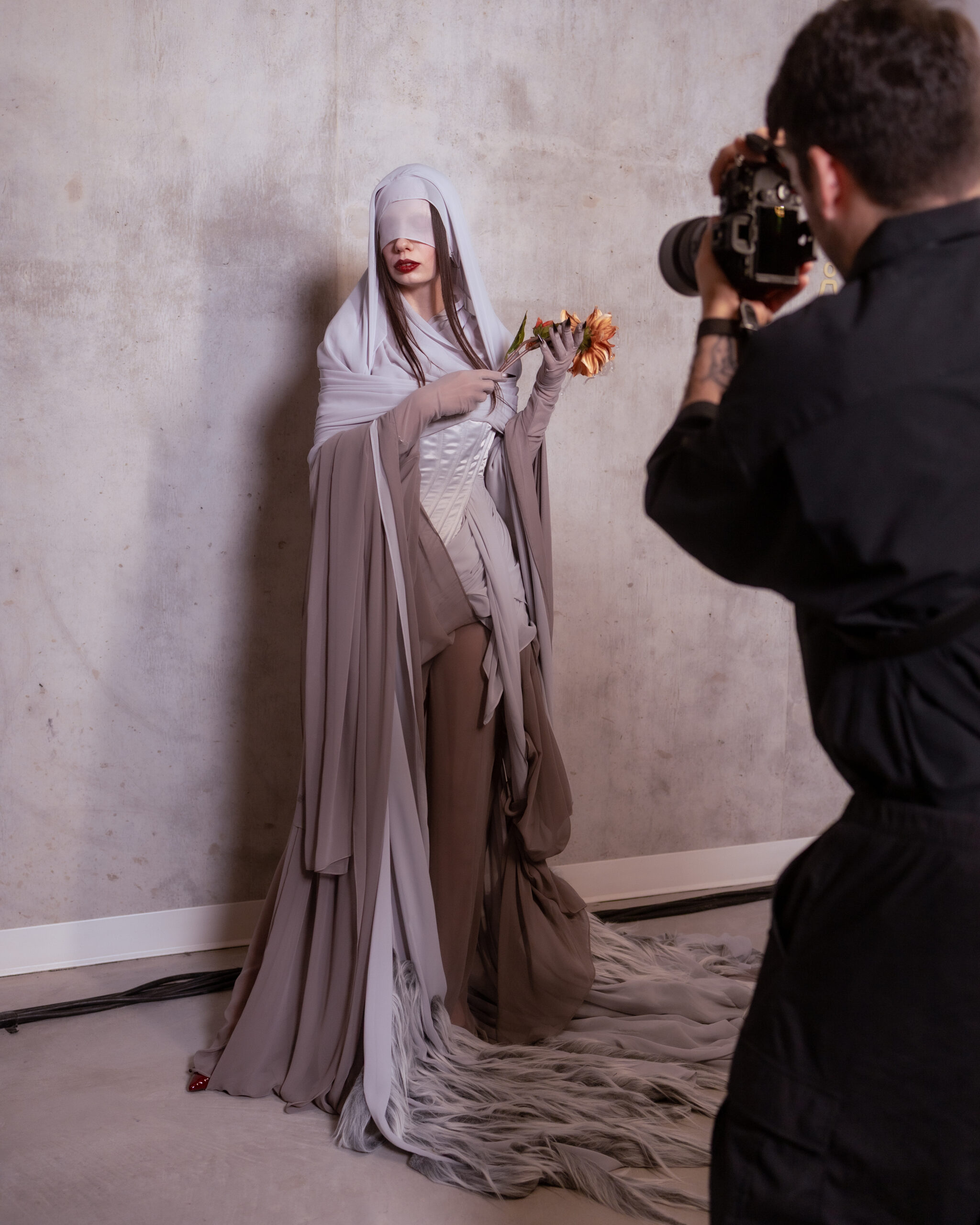
LIKARNЯ by Anton Styntsov, presented at Fashion Art Toronto
Photo by @jeannatheone.
Brand: @styntsov_anton
Event: @fashionarttoronto
In the 21st century — an era defined by the rapid rise of artificial intelligence, where algorithms can already generate clothing, runways, and even digital models — it may seem increasingly difficult to surprise anyone. At least, that’s how it feels at first glance. Yet designers continue to prove the opposite: the human imagination remains unmatched.
At Fashion Art Toronto, designer Anton Styntsov presented his F/W 25 collection LIKARNЯ, which left a powerful impression on the audience. We watched from the front row, holding our breath so as not to miss a single detail. What unfolded on the runway wasn’t produced by artificial intelligence — it was the work of a human being, shaped by experience, emotion, and a mind that creates with intention.
And that is exactly why we couldn’t overlook this collection. We decided to explore its idea and concept more deeply: we spoke with Anton about what inspired LIKARNЯ, how he works with CLO3D, and what role he believes artificial intelligence will play in the future of fashion.
When you first began shaping LIKARNЯ, what initially inspired you? Was there a moment or idea that set the direction for the entire collection?
The architecture, rituals, and emotional contradictions of the hospital environment inspired the LIKARNЯ collection. I approached it as a study of systems — how structure, precision, and procedure intersect with the deeply human experiences that unfold within them.
The concept begins with four “principles” of the hospital — disinfection, regulation, technology, and craft — and then transitions into deeper emotional states through “The Passage,” where the human form moves through four phases: the body opened, the sorrow carried, the pathologist’s final touch, and the soul that rises beyond it all.
It was essential for me to convey this world not literally, but through forms, textures, and construction methods that reflect both its discipline and its fragility.
You’ve mentioned that this collection comes from a deeply personal place. Could you share what experiences or emotions influenced LIKARNЯ and how they shaped its narrative?
Yes, the collection is rooted in very personal experiences. Over the past years, I encountered the hospital not only as a physical institution but also as a metaphor for transition, loss, and renewal. LIKARNЯ became a way for me to process those moments — the tension between sterility and emotion, control and vulnerability, the body and the system.
Creating the collection allowed me to translate these experiences into something structured, intentional, and crafted. This theme also feels atmospheric and expansive to me; there is so much to explore within it. I wanted the collection to avoid any “horror costume” associations and instead become a modern, avant-garde artisan narrative — clear on the surface yet rich for deeper exploration.
When developing LIKARNЯ, what message or feeling did you hope the audience would take away from the collection? And once it reached the runway, did you feel that vision came through?
My message was that the hospital — a place many perceive as cold, sterile, or clinical — is in fact shaped by human hands, emotions, and resilience. With this collection, I wanted to reveal how systems can both confine and protect us, and how beauty can emerge in moments of rupture and reconstruction. I aimed to find a balance between technical rigour and emotional storytelling.
Seeing the audience’s reaction — their attention to the details, the craftsmanship, and the progression from Act I to Act II — I do feel that the message reached them the way I intended. Some people told me they were surprised and fascinated that I chose the hospital as an inspiration, a place often associated with pain or fear, and transformed it into something expressive and meaningful.
For me, it was important to show how much we owe to the people who dedicate their lives to learning and perfecting their craft to help others, especially in difficult times and during war.
As LIKARNЯ began to take shape, was there a look or silhouette that ultimately became the core of the collection — something that defined its visual language?
The central silhouette for me was the corseted, structured form — especially the pieces where I engineered a tension between sharp tailoring and fluid draping. The collection works like a system, so several looks function as “pillars,” but the asymmetrical crimson corset from the Principle of Passion & Craft (Look 4, Act I) ultimately became the defining symbol.
It represents the human engine of the hospital: labour, pressure, heartbeat. Technically, it also carries the architectural language that runs through the entire collection. This tension is further expressed in the contrast between the cold leather look with metal spikes (Look 7, “The Pathologist”) and the final blindfolded figure (Look 8, “Rebirth/Release”), which shifts the story from physicality to transcendence.

Look 4 — Principle of Passion & Craft. Crimson layers, leather, structural strapping — the pulse of the hospital.
Photo by @cosplay | @devansakaria

Look 7 — The Pathologist / The Last Witness. Black leather, veiling, clinical straps — the figure who handles the body at its final stage.
Photo by @cosplay | @devansakaria
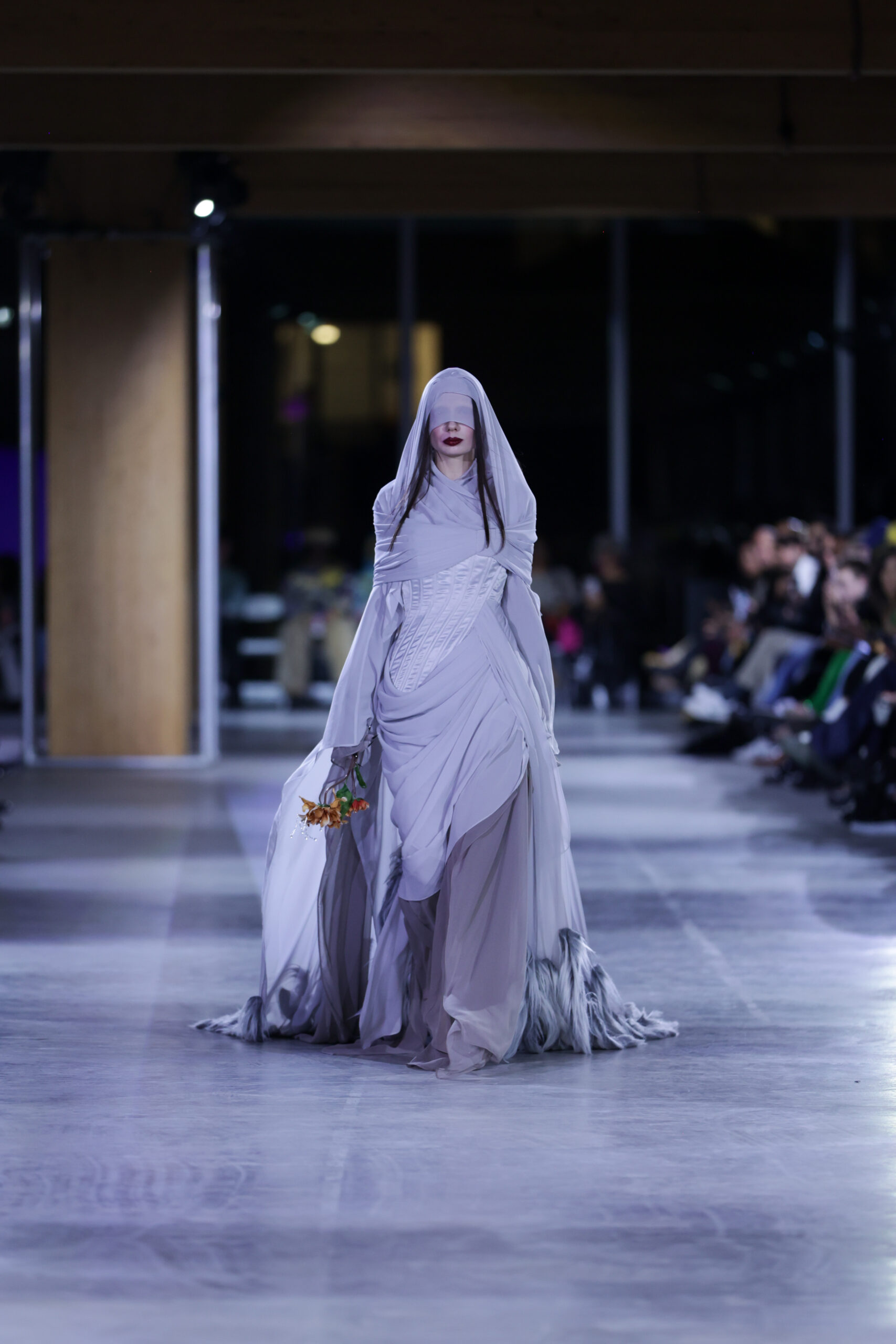
Look 8 — Rebirth / Release. Soft greys wrapped like a final garment.
Photo by @cosplay | @devansakaria
What were the most technically or creatively challenging elements to bring to life while developing LIKARNЯ?
The most challenging elements were the engineered structures — the corded corsetry, the tailored pieces, and the garments that required both architectural precision and emotional fluidity. Many looks involved layering techniques I developed specifically for this project: fringe engineering, bonded hems, hand-placed rhinestone detailing, feather-fur textures, and horsehair-supported silhouettes.
Balancing functionality with symbolism, while ensuring each look stayed true to its “hospital principle,” demanded both technical discipline and extensive experimentation. This is also what sets the collection apart from my previous ready-to-wear line, Litak FW24, where I focused on refining tailoring within simpler silhouettes. With LIKARNЯ, I fully embraced eveningwear — each look became a challenge, involving new techniques, complex corsetry, leatherwork, dramatic draping, and sculptural construction.
How long did the entire process take — from the first sketches to the final runway-ready looks?
I began developing the collection almost immediately after my previous show, Litak FW24. I was genuinely excited to explore a more focused eveningwear line inspired by the hospital environment. The process started with sketching, researching, and building moodboards, shaping the narrative for each principle.
Once the holidays passed, I moved into the construction phase and worked on each look individually, giving myself around a month per piece. Some designs required more time due to their complex silhouettes, engineered structures, extensive fittings, and the amount of hand-stitching and detailing involved.
In the end, I was able to create eight fully developed looks — each crafted with intention, precision, and a high level of technical discipline.
On your website, we can see both traditional sketches and 3D models. How did this transition to a digital format come about, and what motivated you to explore 3D?
I started working with 3D quite early, back when I was finishing my first small sewing courses in my hometown in Ukraine. That’s when I discovered CLO3D, and I became fascinated by the idea of building patterns digitally and testing them on a virtual mannequin. At that time, my sewing skills were still developing, but I loved math — so the logic behind pattern drafting came to me very naturally.
For a long time, I was completely self-taught. I didn’t take any formal courses until after graduating from college, when I finally completed a few online programs. In the beginning, I learned everything through experimentation: drafting, sewing simulations, detailing, realistic finishes, and rendering. Looking back, it was an incredibly interesting journey, and I was genuinely motivated to prove to myself that CLO3D could be a powerful tool for fashion design and construction.
Do you see 3D design as an essential tool for the new generation of designers? If so, why?
Absolutely. For me, 3D design has become an essential part of my workflow, and I believe it offers a tremendous advantage for the new generation of designers. Platforms like CLO3D have helped me enormously in both construction and modeling, because they allow you to test ideas, adjust patterns, and visualize silhouettes with a level of clarity that traditional methods often can’t provide as quickly.
What I appreciate most is how intuitive and accessible the software is. It’s far ahead of many other pattern-making platforms in terms of ease of use and accuracy, which makes it not only a great tool for experimentation, but also a highly effective way to develop technically precise garments.
When developing new ideas, how do you balance traditional sketching with 3D modelling? Are there moments when you naturally return to pencil and paper?
For me, a classic pencil and sketchbook are always the first step — even before any 3D work or the development of a full collection. Sketching helps me explore shapes, emotions, and ideas very freely. For my latest collection, I actually didn’t use 3D rendering at all, simply because I didn’t have the time, but in future projects I definitely plan to incorporate it more. It’s an excellent tool for testing construction logic and refining silhouettes with precision.
I’m very comfortable with traditional drawing, but a sketchbook can’t always explain how a garment will be engineered. That’s where 3D becomes incredibly helpful. It shows the behaviour of patterns and volume beautifully, especially when the design isn’t built directly from the patternmaking idea. So for me, both tools complement each other: sketching is for the concept, and 3D is for structure and problem-solving.
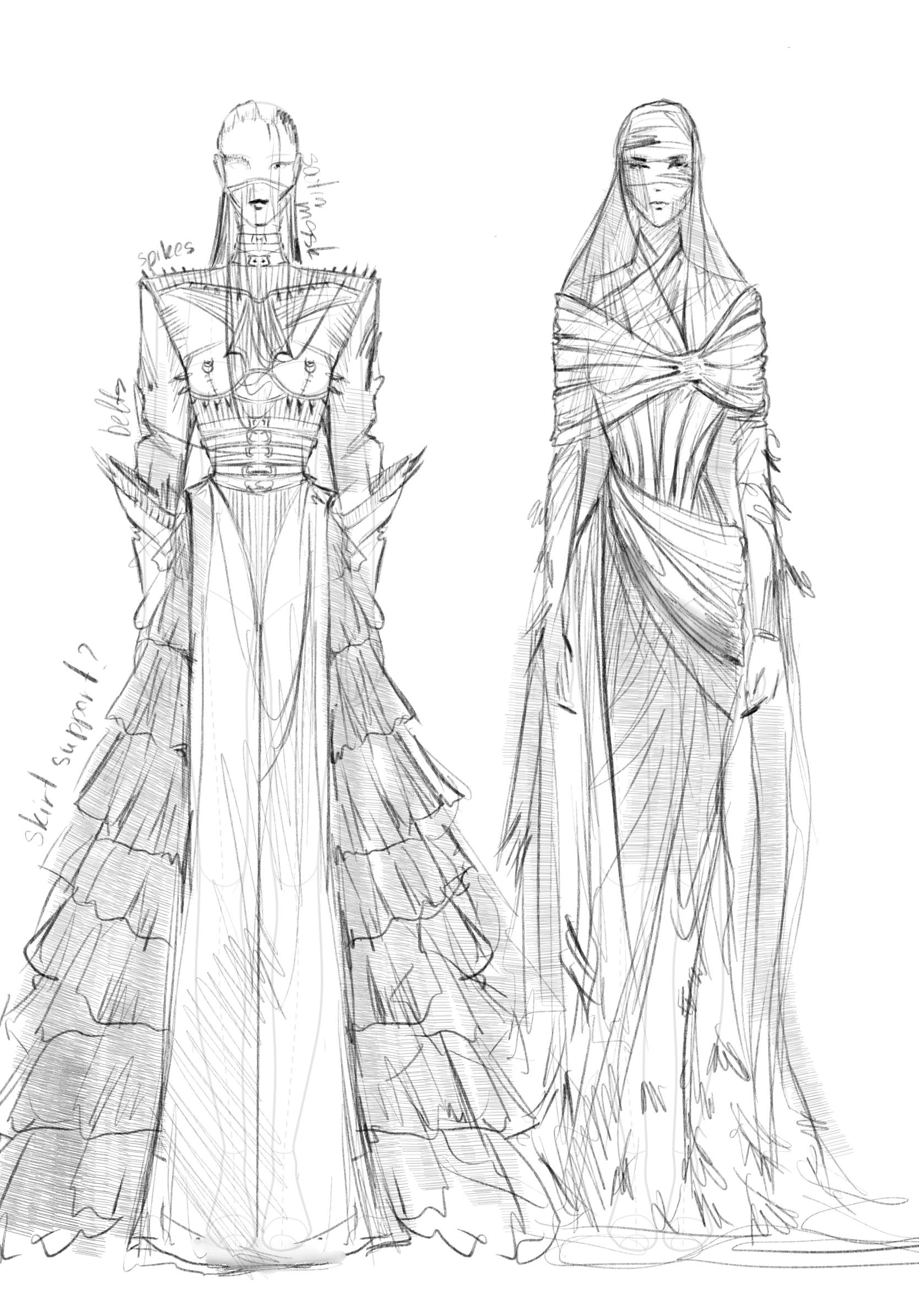
Illustrations courtesy of Anton Styntsov

Illustrations courtesy of Anton Styntsov
What do you see as the most significant advantage of 3D modelling for designers today, and what makes it such a powerful tool?
One of the biggest advantages of 3D modelling today is how quickly the technology is evolving. Sometimes it’s even hard to keep up — the rendering, sampling, and visual accuracy become more realistic every year. You can now match fabrics almost exactly to their real-life behaviour, adjust body measurements on a 3D mannequin, test fit, and even notice details you might miss during a physical fitting, such as stretching, distortion, or tension points.
It’s also incredibly useful when working with advanced clients or custom projects. 3D allows you to create highly detailed renderings and videos that communicate ideas before anything is physically made. This saves time, reduces waste, and provides a much clearer understanding of construction. In many cases, these visualizations become strong marketing tools as well — sometimes even more effective or preferred than presenting the physical sample right away.
Has working with 3D technology changed your overall vision of fashion in any way?
Not really — my vision of fashion hasn’t changed dramatically, because I entered the industry already aware of how widely 3D technologies were being adopted. At first, I didn’t realize how essential they would become, but now even many pattern-making positions list CLO3D as a preferred skill.
There is an entire world of 3D fashion developing rapidly, and it’s clear that the industry is moving even further in that direction.
Which parts of the production process can 3D realistically replace, and which ones will always require traditional craftsmanship?
In mass production, 3D can replace many steps — especially early fittings, sample development, and certain pattern adjustments. It can dramatically reduce the number of physical prototypes, cut costs, and speed up decision-making. You can even test fabric behaviour and plan construction before touching any real material.
But in couture or highly technical work, 3D will never replace everything. You can draft patterns and simulate fit on a virtual mannequin, but the physical fitting remains essential. Garments are created by hand, from real fabrics, and the way they interact with a moving body simply can’t be fully replicated digitally.
So while 3D is a powerful tool, it works best alongside traditional craftsmanship — not instead of it, at least for now.
What are the biggest challenges you face when working with 3D?
One of the main challenges is keeping up with how quickly the software evolves. New updates, tools, and rendering features appear constantly, and it takes time to stay comfortable with all of them. Another challenge is translating certain complex fabric behaviours or couture techniques into 3D — the simulation can get close, but not everything can be represented perfectly.
And of course, working in 3D still requires a strong understanding of real patternmaking; without that foundation, the results can be misleading. So while the tool is incredibly powerful, it demands continuous learning and a steady balance between digital skills and traditional craftsmanship.
Based on your experience, how widely are 3D modelling and AI being used in the fashion industry today?
From what I see, more and more designers are incorporating 3D and AI into their workflow, especially during development, visualization, and communication stages. It’s not universal yet, but it’s quickly becoming a strong advantage — many studios now expect at least basic 3D skills, and some rely on it heavily for prototyping and presentations.
AI is also beginning to play a meaningful role in research, ideation, and even technical tasks. I believe the industry is steadily moving toward deeper integration of these tools, and in the near future, they will become an essential part of the design and production process.
Looking ahead, what creative paths or projects do you see yourself exploring next? What can your audience expect from you in the near future?
Right now, I’m taking a short pause from developing a large collection to focus on learning, smaller custom projects, and expanding my work with 3D. My last two collections became a space for exploration, experimentation, and advancing my technical skills. For my next major project, I want to achieve an even higher level of storytelling, construction, and composition.
In the future, you’ll see a continuation of my eveningwear direction, combined with tailoring and more couture-inspired, avant-garde silhouettes. I’m using this time to grow as a designer and to shape a clearer vision for my brand. The response to my most recent show was incredibly motivating — it inspires me to build new worlds.
At the same time, I’m intentionally not revealing details yet, as I’m “saving” the idea. I believe it has the potential to become a very strong concept for a future show when the right moment comes.
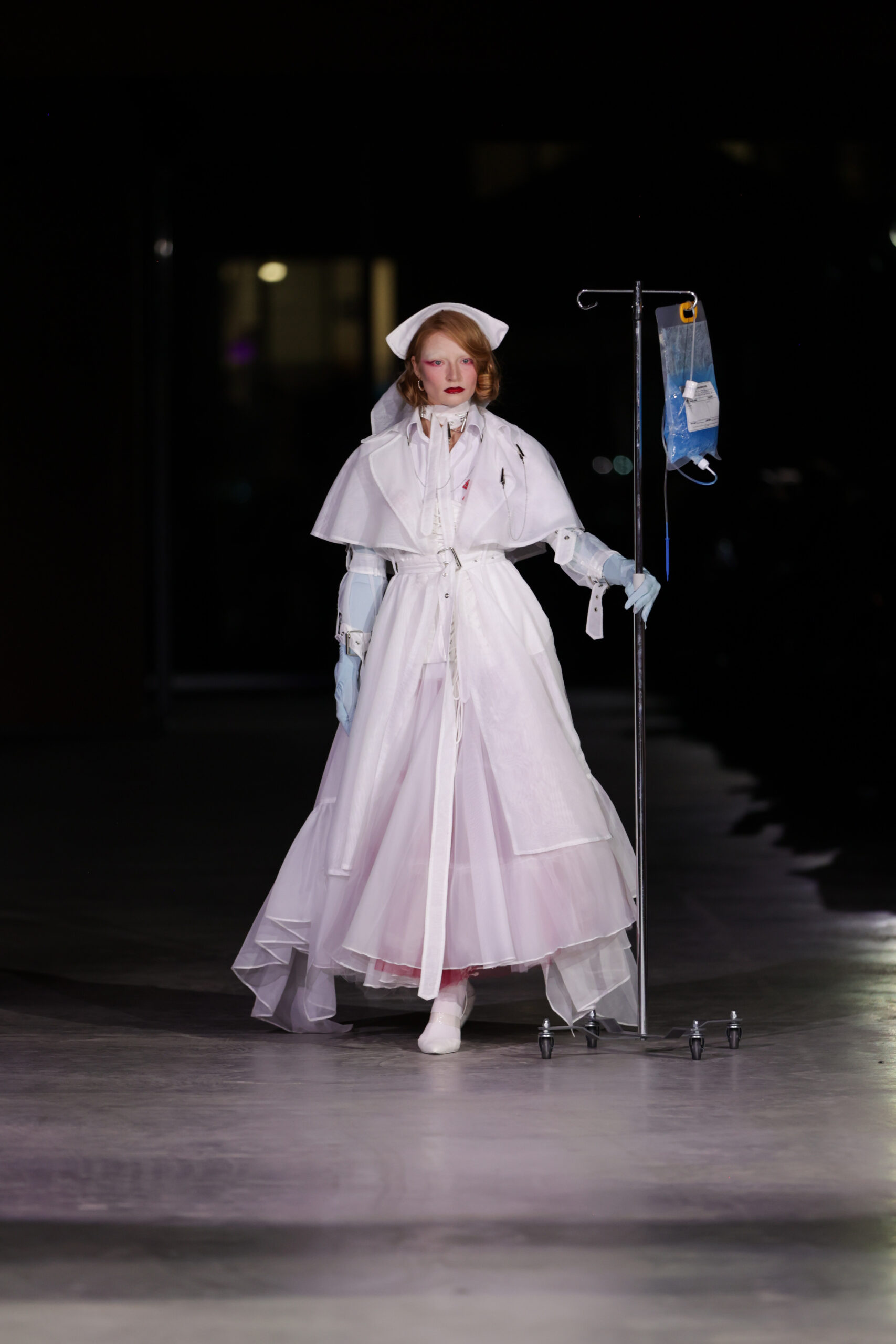
Look 1 — Principle of Disinfection. A sterile silhouette: layered white, coated cotton, medical accessories, and the IV pole as a ceremonial object.
Photo by @cosplay | @devansakaria
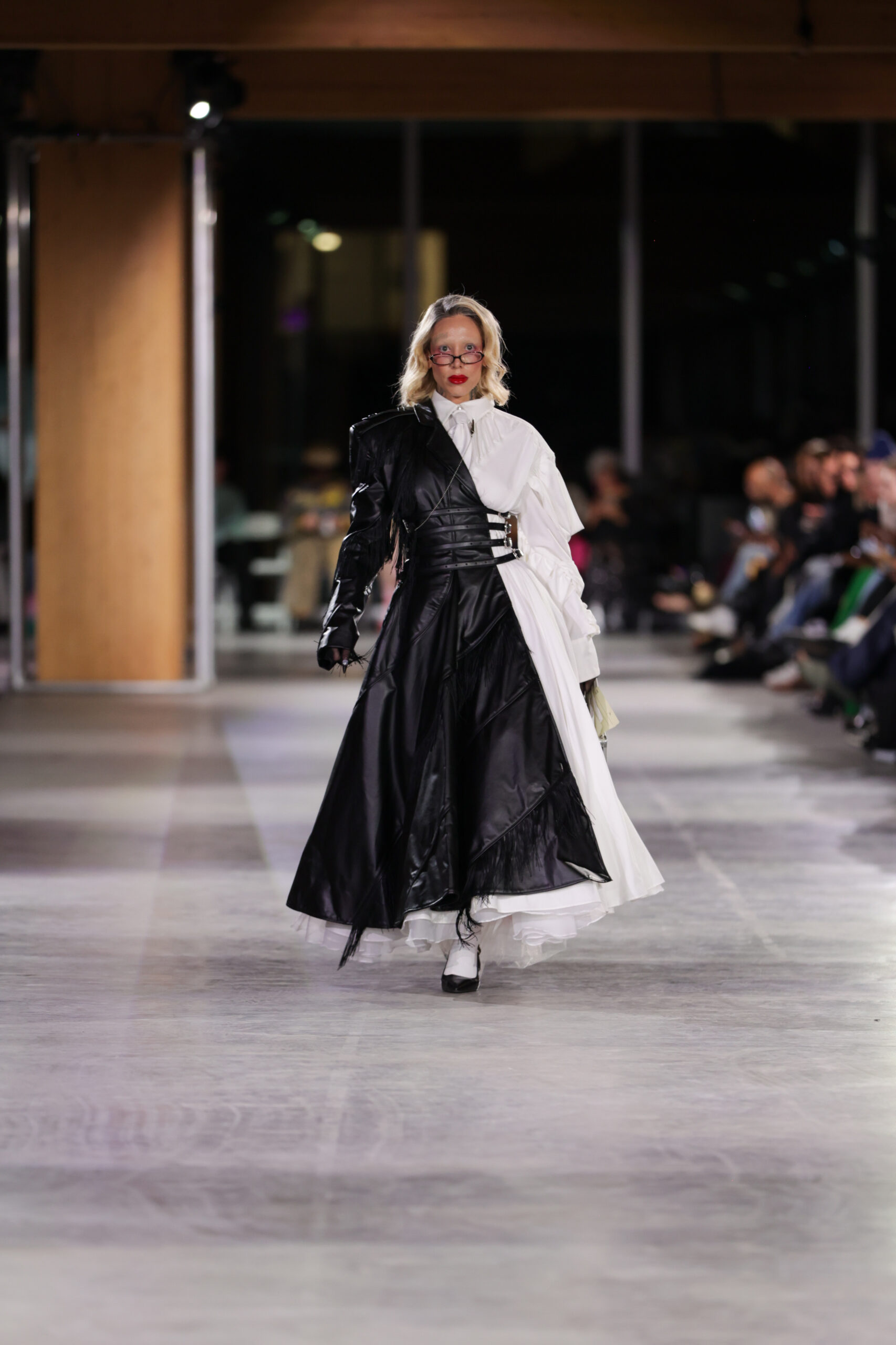
Look 2 — Principle of Regulation. Sharp tailoring, split in black and white, buckles, straps, and administrative layering reflect bureaucracy, hierarchy, and protocol.
Photo by @cosplay | @devansakaria
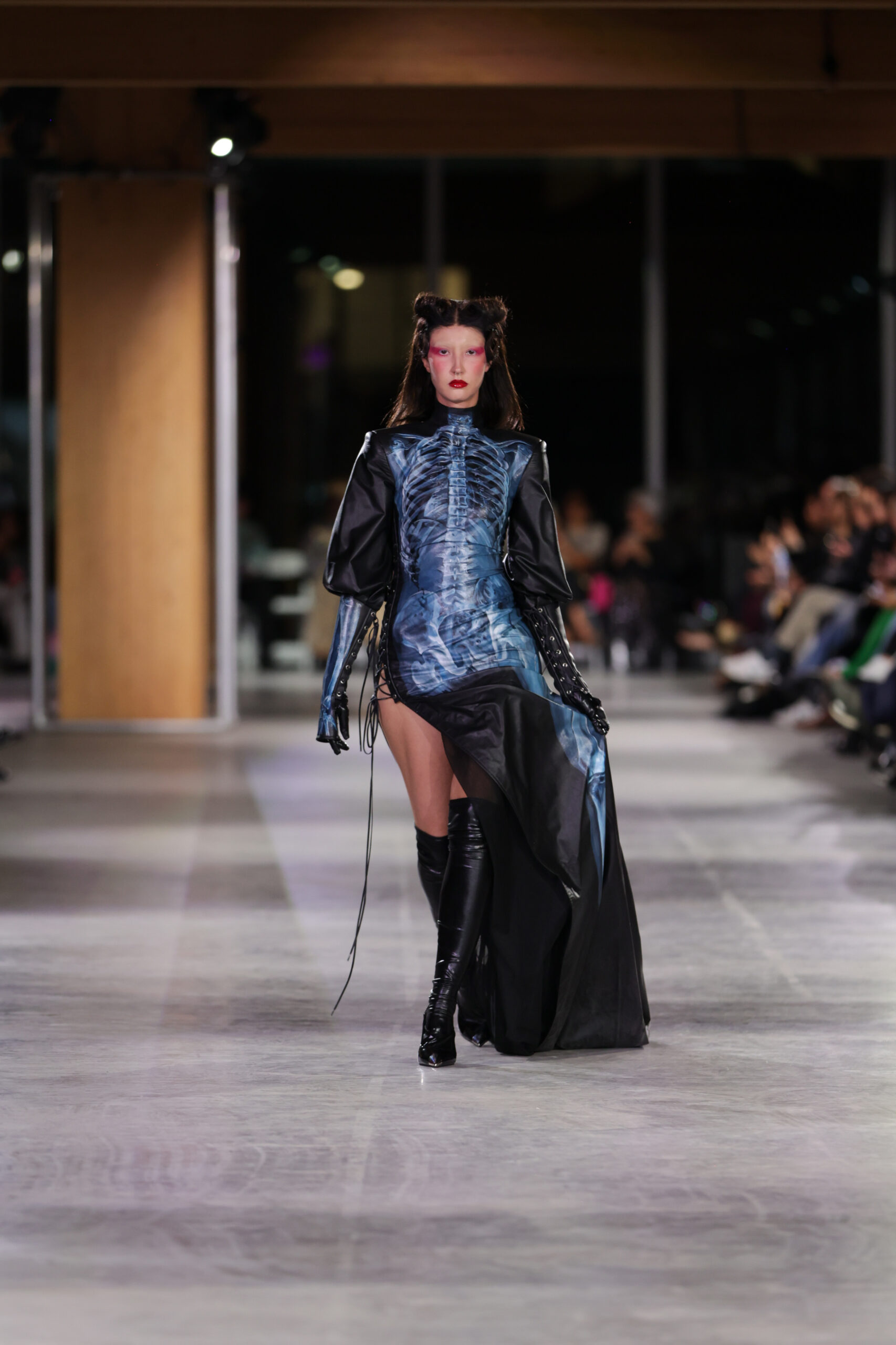
Look 3 — Principle of Technology & Study of the Body. A printed skeletal structure over engineered corsetry and constructed sleeves transforms the wearer into a medical subject, a body mapped for study.
Photo by @cosplay | @devansakaria

Look 5 — The Body in Cross-Section. Red muscular textures pressed under white corsetry and draped fabric.
Photo by @cosplay | @devansakaria
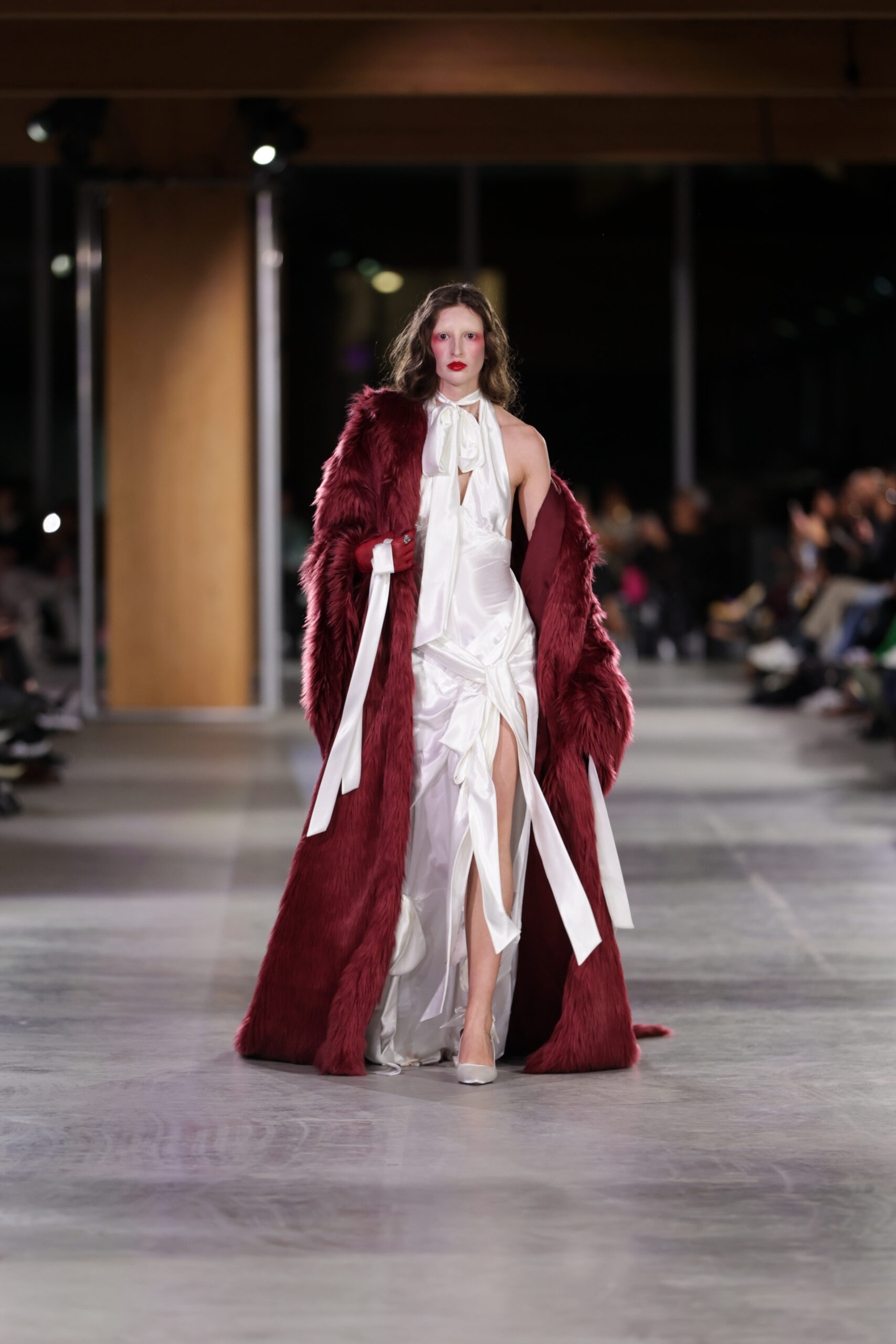
Look 6 — Grief & Mourning. The deep burgundy coat functions as emotional weight; the soft white gown underneath is fragile, shifting, unstable.
Photo by @cosplay | @devansakaria
Anton Styntsov: @styntsov_anton
Event: @fashionarttoronto
Photography: @cosplay | @jeannatheone | @prevalentfocus | @xaintraze | @asianwithcamera | @ladyspeedschtick | @v_isual.s | @sxhj.jpg | @seamus_easton
Photo Editors: @devansakaria | @mio_mak
Models: @ankaawojsas | @desireeseyes | @b.maroosh | @isabellehartt | @kristina.averkiyeva_ | @anyuttaa_a | @_st3lla | @angie_angia
Makeup: @monicacmakeup | @beautybylex121 | @milad.beauty | @mabby.h
Hair: @ania_makeover | @jag.hairart | @donna_hair
Brows: @abbynelsonartistry | @beauty.by.brookezoe
Creative Hair Director:
@dylandoesmyhair
Key Stylist:
@hairpassionbymuffie
Creative MUA Director:
@jezlooks
MUAs: @makeupbybindi_ | @monicanicolemua | @jesspanetta_hmu | @eve.makeup_artist
by Catherine Mills